Scientific Research Database

Research on the Transcendental Meditation and TM-Sidhi Programs
As founded by Maharishi Mahesh Yogi
677 papers · 1,773 findings · 200 journals · 1970–2024
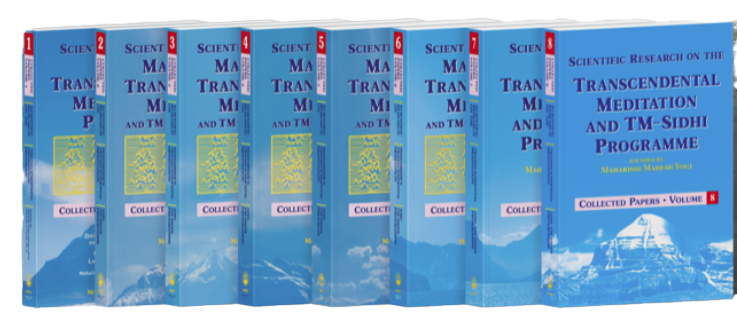
7 papers found
- 2022· World Journal of Social Science· EmpiricalOrme-Johnson, David W.; Cavanaugh, Kenneth L.; Dillbeck, Michael C.; Goodman, Rachel S. (2022). Field-effects of consciousness: A seventeen-year study of the effects of group practice of the Transcendental Meditation and TM-Sidhi programs on reducing U.S. stress. World Journal of Social Science, 9(2).
Seventeen-year time-series study of eight U.S. national stress indicators in relation to the size of the group practicing the Transcendental Meditation and TM-Sidhi programs.
- Sociological—Reduced Crime: Eight U.S. national stress indicators—including crime, infant mortality, drug-related deaths and fatal accidents—improved while the TM and TM-Sidhi group exceeded the required threshold and worsened when the group shrank (p's < .0001).
- 2018· Health Care for Women International· EmpiricalGoldstein, Leslee; Nidich, Sanford I.; Goodman, Rachel; Goodman, David (2018). The effect of transcendental meditation on self-efficacy, perceived stress, and quality of life in mothers in Uganda. Health Care for Women International. doi:10.1080/07399332.2018.1445254.
A three-month controlled study of 81 mothers living in poverty in Uganda (42 TM, 39 wait-list controls) reported improved self-efficacy, lower perceived stress, and better mental and physical quality of life in the TM group.
- Self Development: Greater improvement in general self-efficacy than in wait-list controls.
- Quality of Life: Lower perceived stress and improved mental and physical quality of life relative to controls.
- 2005· Journal of Social Behavior and Personality· Empirical· Collected Papers Vol. 7Nidich, Sanford I.; Schneider, Robert H.; Nidich, Randi J.; Foster, Gloria; Sharma, Hari; Salerno, John; Goodman, Rachel; and Alexander, Charles N. Effect of the Transcendental Meditation program on intellectual development in community-dwelling older adults. Journal of Social Behavior and Personality 17: 217–226, 2005.
Elder adults participating in the Transcendental Meditation program displayed higher levels of cognitive performance than age-matched controls, independent of education level.
- Cognitive Performance: Higher Reasoning Ability
- Cognitive Performance: Higher Verbal Intelligence
- Learning and Memory: Better Long-Term Memory
- + 1 more findings
- 2003· Journal of Offender Rehabilitation· Theoretical/Review· Collected Papers Vol. 7Goodman, Rachel S.; Walton, Kenneth G.; Orme-Johnson, David W.; and Boyer, Robert. The Transcendental Meditation program—A Consciousness-Based developmental technology for rehabilitation and crime prevention. Revised version of a paper that appeared in Journal of Offender Rehabilitation 36: 1–34, 2003.
The authors examine the effectiveness of the Transcendental Meditation program in correctional settings as an expression of the technique’s ability to promote human development to higher states of consciousness, which are analyzed as extending and fulfilling current psychological concepts of human development.
- Review Paper—Rehabilitation: Theoretical and Review Paper—Criminal Rehabilitation and Development of Human Potential
- 2003· Journal of Offender Rehabilitation· Empirical· Collected Papers Vol. 7Alexander, Charles N.; Walton, Kenneth G.; and Goodman, Rachel S. Walpole study of the Transcendental Meditation program in maximum security prisoners I: Cross-sectional differences in development and psychopathology. Journal of Offender Rehabilitation 36: 97–125, 2003.
Prison inmates in Massachusetts, USA, who had previously learned the Transcendental Meditation program, in contrast to control inmates, were found to display significantly higher psychological development and development of consciousness, and significantly lower psychopathology.
- Rehabilitation of Offenders: Lower Psychopathology among Prisoners
- Rehabilitation of Offenders: Higher Personal Development among Prisoners
- Rehabilitation of Offenders: Higher Development of Consciousness among Prisoners
- + 10 more findings
- 2001· Theoretical/Review· Collected Papers Vol. 7Goodman, Rachel. S.; Goodman, David H.; and Wolfson, Richard. A Consciousness-Based approach to human security. In Perspectives on human security: National sovereignty and humanitarian intervention, ed. M. V. Naidu (pp. 189–210). Brandon, Manitoba, Canada: Canadian Peace Research and Education Association, 2001.
The authors propose that the quality of individual and collective consciousness is holistically responsible for the various factors that influence human security in society, and review research studies on enhanced social security and quality of life through group practice of the Transcendental Meditation and TM-Sidhi program.
- Review Paper—Society: Theoretical and Review Paper—Peace and Security in Society
- 1997· Empirical· Collected Papers Vol. 7Goodman, Rachel S.; Orme-Johnson, David W.; Rainforth, Maxwell V.; and Goodman, David H. Transforming political institutions through individual and collective consciousness: The Maharishi Effect and government. Paper presented at the annual meeting of the American Political Science Association, Washington, DC, August 1997. See also Dissertation Abstracts International 58(6): 2385A, 1997.
Presidential approval ratings, media positivity towards the president, and five District of Columbia quality of life variables all showed significant improvement beginning during the period of a large assembly of experts in the Transcendental Meditation Sidhi program in Washington, D.C. in June and July of 1993.
- Sociological—Improved Quality of Life: Improved Quality of Life in National Capital: Decreased Emergency Psychiatric Calls, Decreased Hospital Trauma Cases, Decreased Complaints Against Police, Decreased Accidental Deaths, Reduction of Social Stress Index (Washington, DC, July 1993)
- Sociological—Improved Quality of Life: Improved Quality of National Government: Increased Approval Ratings of Head of State (USA, 1993)
- Sociological—Improved Quality of Life: Increased Media Positivity Toward the Head of State (USA, 1993)