Scientific Research Database

Research on the Transcendental Meditation and TM-Sidhi Programs
As taught by Maharishi Mahesh Yogi
677 papers · 1,773 findings · 200 journals · 1970–2024
74 papers found
- 2022· World Journal of Social Science· EmpiricalOrme-Johnson, David W.; Cavanaugh, Kenneth L.; Dillbeck, Michael C.; Goodman, Rachel S. (2022). Field-effects of consciousness: A seventeen-year study of the effects of group practice of the Transcendental Meditation and TM-Sidhi programs on reducing U.S. stress. World Journal of Social Science, 9(2).
Seventeen-year time-series study of eight U.S. national stress indicators in relation to the size of the group practicing the Transcendental Meditation and TM-Sidhi programs.
- Sociological—Reduced Crime: Eight U.S. national stress indicators—including crime, infant mortality, drug-related deaths and fatal accidents—improved while the TM and TM-Sidhi group exceeded the required threshold and worsened when the group shrank (p's < .0001).
- 2022· Studies in Asian Social Science· EmpiricalCavanaugh, Kenneth L.; Dillbeck, Michael C.; Orme-Johnson, David W. (2022). Evaluating a field theory of consciousness and reduction in U.S. homicide: Analysis of monthly data for 2007–2016. Studies in Asian Social Science, 8(1).
Time-series analysis of monthly U.S. homicide trends from 2007 to 2016 in relation to the size of the group practicing the Transcendental Meditation and TM-Sidhi programs at Maharishi International University.
- Sociological—Reduced Violent Conflict: During 2007–2011, when the U.S. group of TM and TM-Sidhi practitioners exceeded the square-root-of-one-percent threshold, monthly U.S. homicide trends improved significantly (p < .0001); when the group fell below the threshold in 2012–2016, homicide rates rose.
- 2021· Education· EmpiricalVela-Valenzuela, Omar; Dillbeck, Michael C.; Sacristán, Cándido (2021). Effects of the Transcendental Meditation program on intellectual ability, personal well-being and academic performance in Mexican high school students. Education, 142(2), 102–110.
Nine-month longitudinal study of Mexican high school students comparing 50 students practicing Transcendental Meditation with 48 matched non-meditating controls on intelligence, well-being and national exam performance.
- Academic Performance: High school students practicing Transcendental Meditation for nine months scored higher on national academic examinations than matched non-meditating controls.
- Intelligence: Students practicing Transcendental Meditation showed greater improvement on Raven's Progressive Matrices intelligence scores over nine months than matched controls.
- Psychological Health: Students practicing Transcendental Meditation reported higher personal well-being after three months compared with matched controls.
- 2021· JACEP Open· EmpiricalAzizoddin, Desiree R.; Kvaternik, Noelia; Zhou, Guohai; Hasdianda, Mohammad Adrian; Johnsky, Lily; Im, Dana; Boyer, Edward W.; Beck, Meghan; Jones, Natasha; Chai, Peter R. (2021). Heal the Healers: A pilot study evaluating the feasibility, acceptability, and exploratory efficacy of a Transcendental Meditation intervention for emergency clinicians during the coronavirus disease 2019 pandemic. JACEP Open, 2(6), e12619.
Single-arm pilot study of a three-month Transcendental Meditation intervention for 32 emergency physicians, nurses and physician assistants at two urban hospitals during the COVID-19 pandemic, assessing feasibility, burnout and psychological health.
- Organizational Performance and Well-Being: Thirty-two emergency clinicians (physicians, nurses and physician assistants) at two urban hospitals learned Transcendental Meditation during the COVID-19 pandemic; 90.6% attended at least six of eight training sessions.
- Psychological Health: Participants showed significant reductions in burnout (Cohen's d = 0.43–0.45) and in symptoms of depression, anxiety, stress and sleep disturbance (d = 0.70–0.87) over three months.
- Organizational Performance and Well-Being: This was a single-arm pilot without a control group, so improvements cannot be attributed to TM alone.
- 2019· Psychological Reports· EmpiricalBandy, Carole L.; Dillbeck, Michael C.; Sezibera, Vincent; Taljaard, Lian; Wilks, Mirah; Shapiro, David; de Reuck, Jody; Peycke, Richard (2019). Reduction of PTSD in South African University Students Using Transcendental Meditation Practice. Psychological Reports, advance publication, 1–16.
Nonrandomized comparison of 34 TM students and 34 comparison students at different South African universities reported decreases in PTSD symptoms and depression in the TM group.
- Psychological Health: PTSD symptoms and depression decreased relative to comparison students; outcomes were associated with regularity of TM practice.
- 2018· Journal of Maharishi Vedic Research Institute· EmpiricalCavanaugh, Kenneth L.; Gelderloos, Paul; Dillbeck, Michael C. (2018). Group practice of the Transcendental Meditation-Sidhi program and improved U.S.-Soviet relations. Journal of Maharishi Vedic Research Institute, 8, 125–164.
Time-series analysis of 1979–1986 Soviet behavior toward the United States reported increased cooperation and reduced conflict associated with four World Peace Assemblies involving large TM-Sidhi groups.
- Sociological—Reduced Violent Conflict: Four World Peace Assemblies were associated with more cooperative and less conflictual Soviet behavior toward the United States in monthly event data.
- 2017· SAGE Open· EmpiricalDillbeck, Michael C.; Cavanaugh, Kenneth L. (2017). Group Practice of the Transcendental Meditation and TM-Sidhi Program and Reductions in Infant Mortality and Drug-Related Death: A Quasi-Experimental Analysis. SAGE Open, 7(1), 1–15.
Two national time-series analyses of 2002–2010 data, examining deaths within the first week of life and drug-related fatalities in relation to the 2007–2010 group-practice period. The infant measure is early neonatal mortality, not every death during the first year of life. Drug-related mortality showed slower growth relative to its earlier trend; the reported percentage is not a claim that the observed death rate fell by that percentage each year.
- Sociological—Improved Quality of Life: The authors estimated an average annual 3.12% reduction in early neonatal mortality relative to the modelled pre-intervention trend.
- Sociological—Improved Quality of Life: The authors estimated an average annual 7.61% reduction in drug-related fatalities relative to the modelled prior trend, reflecting slower growth than predicted.
- Sociological—Improved Quality of Life: Both indicators showed statistically significant trend shifts after adjustment for prior trends, seasonality, and autocorrelation; these are quasi-experimental associations.
- 2017· Journal of Consciousness Studies· EmpiricalCavanaugh, Kenneth L.; Dillbeck, Michael C. (2017). The Contribution of Proposed Field Effects of Consciousness to the Prevention of US Accidental Fatalities: Theory and Empirical Tests. Journal of Consciousness Studies, 24(1–2), 53–86.
Analyzes monthly U.S. motor-vehicle and other accidental-fatality data from 2002–2010 in relation to group TM/TM-Sidhi practice during 2007–2010. Uses intervention models and discusses competing explanations. Although the PDF carries a 2016 copyright notice, the verified journal issue is dated 2017.
- Sociological—Reduced Accidents: The authors estimated an average annual 5.24% downward change relative to the modelled prior motor-vehicle fatality trend, controlling for vehicle miles travelled.
- Sociological—Reduced Accidents: The authors estimated an average annual 3.38% downward change relative to the modelled prior trend in other accidental fatalities.
- Sociological—Reduced Accidents: Both series showed statistically significant trend changes in the predicted period after adjustment for prior trends, seasonality, and autocorrelation; the design does not establish causation.
- 2017· Journal of Maharishi Vedic Research Institute· EmpiricalCavanaugh, Kenneth L.; Dillbeck, Michael C. (2017). Researching U.S. Urban Murder Rates and Group Practice of the Transcendental Meditation and TM-Sidhi Program: Evaluation of a Prospective Quasi-Experiment. Journal of Maharishi Vedic Research Institute, 5, 11–40.
A separately published version of the urban-murder research in paper 626, with a different title, journal, and pagination. It uses the same 206-city data and intervention period; it must not be presented as independent replication of paper 626.
- Sociological—Reduced Crime: Reports a downward urban homicide-rate trend shift during 2007–2010 in the same quasi-experimental research as paper 626.
- Sociological—Reduced Crime: Reports a model-estimated 28.4% cumulative reduction and 4,136 fewer urban murders than forecast; these repeat the shared study results rather than adding a new sample.
- 2017· Journal of Health and Environmental Research· EmpiricalCavanaugh, Kenneth L.; Dillbeck, Michael C. (2017). Field Effects of Consciousness and Reduction in U.S. Urban Murder Rates: Evaluation of a Prospective Quasi-Experiment. Journal of Health and Environmental Research, 3(3-1), 32–43.
Prospective quasi-experimental analysis of monthly homicide rates in 206 U.S. urban areas from 2002–2010, comparing pre-intervention trends with 2007–2010, when the group-practice threshold was met or approached. Results are statistical associations and model estimates, not randomized evidence of causation.
- Sociological—Reduced Crime: The model found a downward shift in the urban homicide-rate trend during 2007–2010, controlling for prior trends, seasonality, and autocorrelation.
- Sociological—Reduced Crime: The authors estimated a 28.4% cumulative reduction relative to the modelled prior trend, equivalent to 7.1% annually.
- Sociological—Reduced Crime: The authors estimated 4,136 fewer urban murders than their forecast; this is a model-based estimate, not a directly measured number caused by group practice.
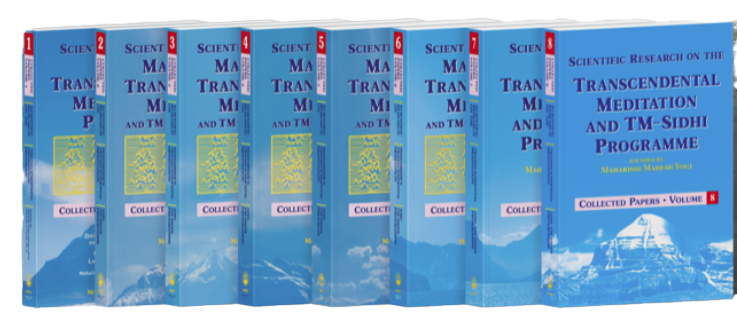
- 2005· Journal of Social Behavior and Personality· Empirical· Collected Papers Vol. 7Dixon, Carol A.; Dillbeck, Michael C.; Travis, Frederick; Msemaje, Horus I.; Clayborne, B. Mawiyah; Dillbeck, Susan L.; Alexander, Charles N. Accelerating cognitive and self-development: Longitudinal studies with preschool and elementary school children. Journal of Social Behavior and Personality 17: 65–91, 2005.
Two longitudinal studies of elementary school students found improvements in cognitive factors underlying performance on mental tests among students who learned the Transcendental Meditation technique, or Maharishi’s Word of Wisdom technique for those under 10 years of age.
- Cognitive Performance: Increased General Intellectual Performance
- Cognitive Performance: Increased Psychological Differentiation
- Cognitive Performance: Increased Analytical Ability
- + 1 more findings
- 2003· Journal of Offender Rehabilitation· Empirical· Collected Papers Vol. 7Orme-Johnson, David W.; Dillbeck, Michael C.; and Alexander, Charles N. Preventing terrorism and international conflict: Effects of large assemblies of participants in the Transcendental Meditation and TM-Sidhi programs. Journal of Offender Rehabilitation 36: 283–302, 2003.
Time series analyses indicated that during periods in 1983–1985 of three large assemblies of experts in the Transcendental Meditation Sidhi program approaching or exceeding in number the square root of one per cent of the world’s population, international conflict decreased significantly and fatalities and injuries due to international terrorism also decreased significantly.
- Sociological—Reduced Violent Conflict: Decreased International Conflict (International, Three Periods in 1983–1985)
- Sociological—Reduced Violent Conflict: Decreased International Terrorism (International, Three Periods in 1983–1985)
- 2001· Theoretical/Review· Collected Papers Vol. 7Dillbeck, Michael C.; and Dillbeck, Susan L. Consciousness-Based education for total development of the brain in contrast to existing education which partially develops the brain: Summary of scientific research. In Ideal India, pp. 47–74, Vlodrop, The Netherlands: Maharishi University of Management, 2001.
The authors describe scientific research findings indicating that in contrast to the current approach to education, Consciousness-Based education develops the holistic functioning of the human brain.
- Review Paper—Physiology: Research Review—Transcendental Consciousness Promoting Holistic Brain Functioning
- 1997· Alternative Therapies in Clinical Practice· Empirical· Collected Papers Vol. 7Smith, D. E.; Dillbeck, M. C.; and Sharma, H. M. Erythrocyte sedimentation rate and Transcendental Meditation. Alternative Therapies in Clinical Practice 4: 35–37, 1997.
This large-sample study found that practice of the Transcendental Meditation technique was associated with lower erythrocyte sedimentation rate, and higher incidence of zero erythrocyte sedimentation rate. These findings, independent of age and gender, are indicative of lower stress and less negative effects of aging.
- Health—General: Lower Values of Erythrocyte Sedimentation Rate
- Health—General: More Frequent Occurrence of Zero Erythrocyte Sedimentation Rate
- 1996· Empirical· Collected Papers Vol. 6Dillbeck, M. C., and Rainforth, M. V. Impact assessment analysis of behavioral quality of life indices: Effects of group practice of the transcendental meditation and TM-Sidhi program. In American Statistical Association, 1996 Proceedings of the Social Statistics Section, pp. 38–43. Alexandria, VA: American Statistical Association, 1996.
The first study in this paper found that during periods when the size of a group of participants in the Transcendental Meditation Sidhi program in the USA exceeded the square root of one per cent of the national population, there was a significant improvement in a comprehensive quality of life index combining seven monthly behavioral variables (reduced homicide, reduced suicide, reduced motor vehicle fatalities, reduced death due to other accidents, reduced notifiable diseases, reduced alcohol consumption, and reduced cigarette consumption), controlling for changes in national economic trends (unemployment rate). A replication study in Canada found that during periods when the size of the same group of participants in the TM-Sidhi program exceeded the square root of one per cent of the national populations of the USA and Canada together, there was a significant improvement in a comparable Canadian quality of life index comprising available behavioral variables (reduced homicide, reduced suicide, reduced motor vehicle fatalities, and reduced cigarette consumption), controlling for changes in national unemployment trends.
- Sociological—Improved Quality of Life: Improvements Controlling for Economic Changes on a Monthly Index Including Motor Vehicle Fatalities, Homicide, Suicide, Deaths Due to Accidents (other than Motor Vehicle), Notifiable Diseases, Alcohol Consumption, Cigarette Consumption (United States, 1970–1986)
- Sociological—Improved Quality of Life: Improvements Controlling for Economic Changes on a Monthly Index Including Motor Vehicle Fatalities, Homicide, Suicide, Cigarette Consumption (Canada, 1972–1986)
- 1995· Psychological Reports· Empirical· Collected Papers Vol. 6Assimakis, P. D., and Dillbeck, M. C. Time series analysis of improved quality of life in Canada: Social change, collective consciousness, and the TM-Sidhi program. Psychological Reports 76: 1171–1193, 1995.
The two studies reported in this paper found improved quality of national life in Canada during periods when the size of a group of participants in the Transcendental Meditation Sidhi program in the USA exceeded the square root of one per cent of the combined national populations of the USA and Canada. The first study found significant improvement in a weekly index measured by the sum of motor vehicle fatalities, homicides, and suicides; the second study documented significant improvement in a monthly index that combined the variables of motor vehicle fatalities, homicide, suicide, cigarette consumption, and work days lost in strikes.
- Sociological—Improved Quality of Life: Improvements on a Weekly Index Including Motor Vehicle Fatalities, Homicide, and Suicide (Canada, 1983–1985)
- Sociological—Improved Quality of Life: Improvements on a Monthly Index Including Motor Vehicle Fatalities, Homicide, Suicide, Cigarette Consumption, and Worker-Days Lost in Strikes (Canada, 1972–1986)
- 1994· Alcoholism Treatment Quarterly· Research Review· Collected Papers Vol. 6Orme-Johnson, D. W. Transcendental Meditation as an epidemiological approach to drug and alcohol abuse: Theory, research, and financial impact evaluation. Alcoholism Treatment Quarterly 11: 119–168, 1994.
The author reviews research indicating that the Transcendental Meditation program reduces risk factors for substance abuse and increases factors that protect against abuse; the paper also reviews research demonstrating effective reduction of alcohol and drug use through this program.
- Review Paper—Rehabilitation: Review Paper—Reduced Substance Abuse
- 1992· Journal of Behavioral Medicine· Empirical· Collected Papers Vol. 6Glaser, J. L.; Brind, J. L.; Vogelman, J. H.; Eisner, M. J.; Dillbeck, M. C.; Wallace, R. K.; and Orentreich, N. Elevated serum dehydroepiandrosterone sulfate levels in practitioners of the Transcendental Meditation (TM) and TM-Sidhi program. Revised and updated version of paper that appeared in Journal of Behavioral Medicine 15: 327–341, 1992.
This study found that older persons who participate in the Transcendental Meditation program, and female participants at all age levels, show biochemical indications of greater youthfulness, as measured by higher levels of serum dehydroepiandrosterone sulfate.
- Biochemical: Increased DHEA-S Levels in Female and Older Male Practitioners of the Transcendental Meditation and TM-Sidhi program
- 1991· Modern Science and Vedic Science· Theoretical/Review· Collected Papers Vol. 6Dillbeck, M. C. The Bhagavad-Gita: A case study in Maharishi’s Vedic psychology. Modern Science and Vedic Science 4, 97–134, 1991.
This paper analyses the Bhagavad-Gita as a model case study from the Vedic Literature, providing knowledge of the full range of human development to higher states of consciousness. The Vedic knowledge of development of consciousness is systematically brought to light in Maharishi’s Vedic Psychology and is supported by research on the Transcendental Meditation and TM-Sidhi program.
- Review Paper—Psychology: Theoretical and Review Paper—Psychology and Maharishi Vedic Science
- 1991· Personality and Individual Differences· Empirical· Collected Papers Vol. 6Cranson, R. W.; Orme-Johnson, D.W.; Gackenbach, J.; Dillbeck, M. C.; Jones, C. H.; and Alexander, C. N. Transcendental Meditation and improved performance on intelligence-related measures: A longitudinal study. Personality and Individual Differences 12: 1105–1116, 1991.
This study found that university students practicing the Transcendental Meditation and TM-Sidhi program demonstrated, in comparison to control students, improved performance on a psychometric intelligence test, improvement in reaction time measures correlated with general intelligence (faster choice reaction time, lower standard deviation of choice reaction time), and faster simple reaction time.—
- Motor Performance: Faster Simple Reaction Time
- Cognitive Performance: Improved Intelligence Test Performance
- Motor Performance: Improvement in Reaction Time Measures Correlated with General Intelligence (Faster Choice Reaction Time, Lower Standard Deviation of Choice Reaction Time)